Insights · Method
LeaderShop – from people to measurable impact
LeaderShop is Cronquist Consult's holistic approach to leadership, organisational development and business development — connecting people, processes, customers and results.
The model brings together four perspectives: Leadership, Management & Execution, Customer Value and Business. Lasting organisational development is not created by optimising one area in isolation. Leadership must become action, action must create value for customers, and that value must be visible in the business.
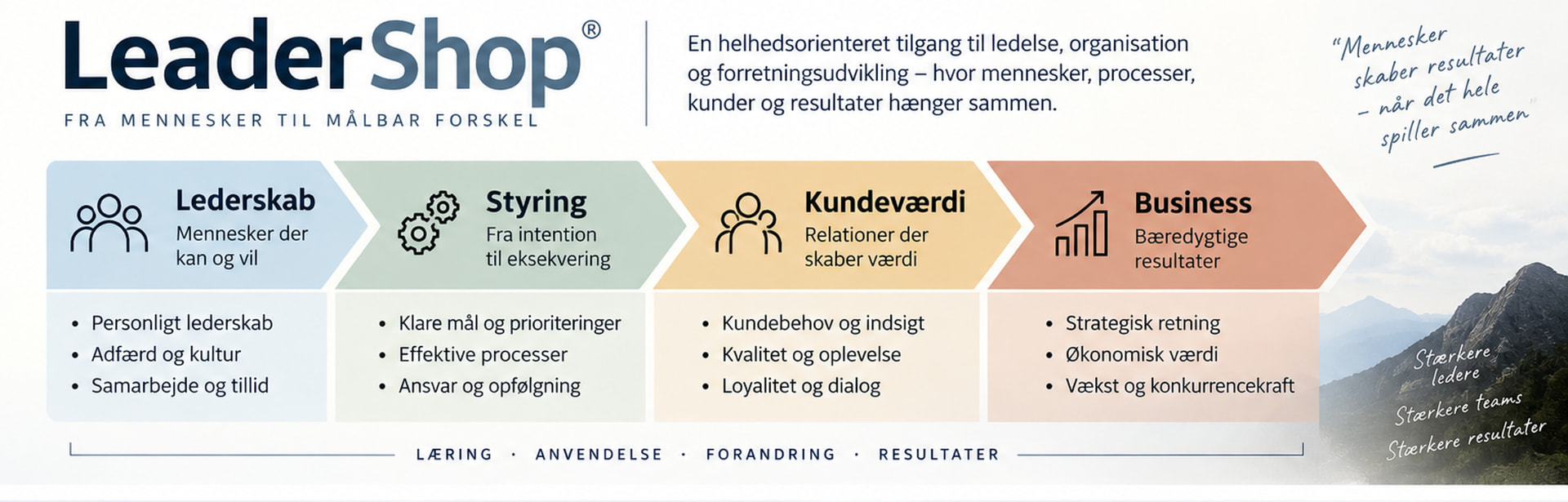
When everything needs to work together
Many development initiatives focus on one part of the organisation at a time: leadership, processes, customer experience or financial performance. LeaderShop uses the four perspectives to keep the connections visible.
- Strategic direction affects the leadership behaviour an organisation needs.
- Leadership behaviour affects the ability to execute.
- Customer insight can change priorities and processes.
- Processes and behaviour affect the value customers experience.
- Business priorities affect every other perspective.
The arrows show movement from people to measurable impact — not four isolated phases.
Leadership – people who are able and willing
Personal leadership · Behaviour and culture · Collaboration and trust
Strategy only becomes organisationally relevant when people are able and willing to translate it into behaviour. The central question is: What leadership behaviour does the organisation need to succeed with its strategy?
3H addresses how learning becomes behaviour. Shared High Team Standards make desired team behaviour explicit, practicable and possible to reinforce. LeaderShop adds the wider organisational view connecting that behaviour with processes, customers and business.
Management & Execution – from intention to execution
Clear objectives and priorities · Effective processes · Responsibility and follow-up
Strategy without prioritisation, responsibility and follow-up risks remaining an intention. Management & Execution connects ambition with everyday execution.
This is not control for its own sake. It is about creating enough clarity around priorities, processes, responsibility and follow-up for strategy to become coordinated action. The Strategy and Execution page explores this perspective further.
Customer Value – relationships that create value
Customer needs and insight · Quality and experience · Loyalty and dialogue
How does the organisation know whether what it does genuinely creates value for the customer? LeaderShop places Customer Value between internal execution and business results.
Customer insight is therefore not simply a marketing measure. It can inform leadership, processes and strategic priorities. Customer Deep Dive is one practical way Cronquist works with customer insight and the movement from insight to action.
Business – sustainable results
Strategic direction · Financial value · Growth and competitiveness
The Business perspective keeps organisational development connected with what the company fundamentally needs to achieve. Development is not an end in itself. It should support strategic direction, value creation and the company's ability to create sustainable results.
This does not guarantee that a particular leadership initiative will produce a particular financial result. It keeps attention on the business task the effort is intended to support. Read more about organisational development.
Development only counts when it is applied
LEARNINGAPPLICATIONCHANGERESULTS
Learning is not the endpoint. New knowledge and capabilities need to be applied in everyday work, influence behaviour and processes, and contribute to the intended organisational change. 3H explains the learning movement; LeaderShop maintains the connection to customers and business.
Four questions for the leadership team
The four perspectives can provide a practical structure for leadership-team dialogue.
LEADERSHIP
“Do we have the behaviour and culture our strategy requires?”
MANAGEMENT & EXECUTION
“Are our objectives, priorities, processes and responsibilities clear?”
CUSTOMER VALUE
“Do we know what customers genuinely experience as valuable?”
BUSINESS
“Can we see the connection between our development effort and our strategic direction?”
These questions are not a test, assessment or scoring system. They are simply a way to keep the connections visible in leadership dialogue.
Where does LeaderShop come from?
LeaderShop was developed by Mads Cronquist in 2007 in connection with his work for Eltel Networks. The work began while he was working as a consultant for the company, and continued after he joined Eltel Networks as HR Director a few months later.
The model was developed as a practical framework for connecting leadership, organisation, customers and business. LeaderShop was subsequently developed further through practical work with leadership, organisation and business.
In spring 2012, the model played a central role in two parallel pieces of work. Mads Cronquist wrote his CBA examination paper entitled “LeaderShop – nøglen til succesfuld strategieksekvering” while also writing his book Lederens inspirationsguide, in which the LeaderShop model is described and explored. The CBA examination paper was awarded the highest Danish grade, 12, following an oral defence before four examiners from higher education institutions in Denmark and Sweden.
The development of LeaderShop was inspired in part by work on strategic coherence in Balanced Scorecard and by Dave Ulrich's work on the different roles of HR. Through practical application, these inspirations were translated into LeaderShop's own structure of Leadership, Management & Execution, Customer Value and Business.
LeaderShop is not Balanced Scorecard, nor is it an official extension of Balanced Scorecard or Human Resource Champions. The individual dimensions should not be treated as equivalents.
LeaderShop in practice
LeaderShop was first developed and applied in the work with Eltel Networks in 2007 and has since been used as a framework in different leadership and organisational development programmes.
Frequently asked questions
- What is LeaderShop?
- LeaderShop is Cronquist Consult's holistic approach to leadership, organisational development and business development. It keeps the connections between people, processes, customers and results visible.
- What are the four perspectives in LeaderShop?
- The four perspectives are Leadership, Management & Execution, Customer Value and Business. They influence one another and should not be understood as four isolated or rigid phases.
- How is LeaderShop used in practice?
- LeaderShop can provide a shared perspective for leadership-team dialogue about behaviour and culture, objectives and processes, customer experience and the organisation's strategic direction.
- How does LeaderShop relate to strategy and execution?
- LeaderShop helps explore which leadership behaviour, processes and responsibilities need to connect strategic ambition with coordinated action in everyday work.
- How does customer value fit into LeaderShop?
- Customer Value sits between internal execution and business results. Customer insight can therefore inform leadership, processes and strategic priorities, rather than serving only as a marketing measure.
- How is LeaderShop different from Balanced Scorecard?
- LeaderShop is not Balanced Scorecard. Balanced Scorecard is one source of inspiration concerning strategic coherence, while LeaderShop was developed by Mads Cronquist as a practical model structured around Leadership, Management & Execution, Customer Value and Business.
Should leadership, customers and business connect more clearly?
Cronquist uses LeaderShop as a perspective in leadership, organisational development and strategy execution.
Talk to Mads Cronquist