
Option 1
Strategy seminars and workshops
Typically 1–2 days
- Create shared direction and clear priorities
- Engage leaders and key employees
- Practical tools and realistic cases
- Tailored to your organisation and industry
Strategy and execution
We help you turn strategy into concrete action and lasting results – through strategy seminars, workshops and practical advisory support that create clear direction, priorities, execution capability and engagement across the organisation.
Option 1
Typically 1–2 days
Option 2
For CEOs, executive teams and leaders
Your benefits


Explore our methods, programmes and client examples below
Strategy only creates value when it changes what the organisation actually does. We work with the whole chain: strategy, priorities, leadership, behaviour, execution and business results — not only the seminar where the strategy is written.
Are you responsible for – or do you want to learn – turning strategy into action and results?
Cronquist Consult offers focused support for strategic leadership and execution – either as a practical 1–2 day course for leaders and leadership teams, or as one-to-one strategic advisory for CEOs, managing directors and senior leaders.
A tailored 1–2 day in-house course built around your own strategy and current challenges.
We work hands-on with strategic priorities, leadership behaviour, organisation, involvement and execution – so the strategy is turned into action in day-to-day work.
See also leadership team development →Confidential one-to-one sparring for leaders with strategic responsibility who want an experienced external sounding board.
We start from your current strategic choices, leadership challenges and organisation – from decision to implementation and results.
Read about executive coaching →Cronquist Consult doesn't sell a standard workshop. Each process is designed around the client's actual business and organisational challenge.
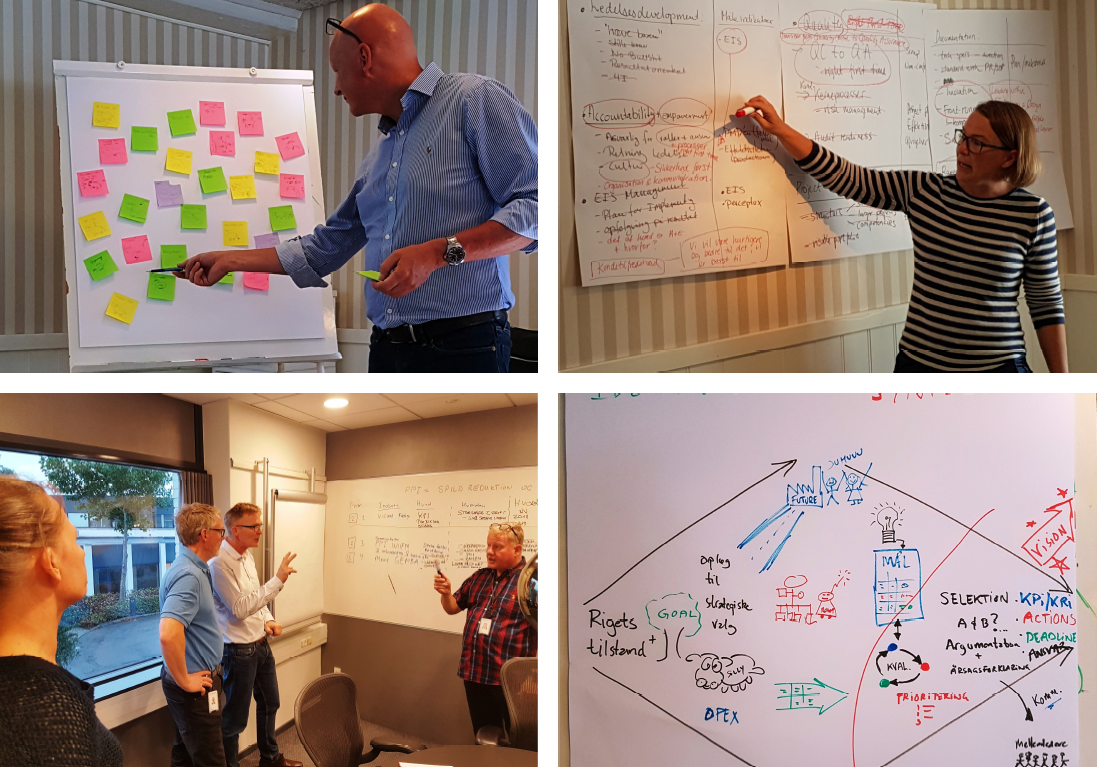
Strategy design + leadership alignment + middle-management involvement
An initial 1.5-day strategy-design workshop for a new six-person C-level leadership team, focused on an Operational Excellence strategy. The strategy work was combined with building relationships and trust through practical exercises – together with ideation, strategic focus areas, a scoreboard, KPIs/KRIs, actions, deadlines, responsibilities and a concrete roadmap. The middle-management layer of around 15 people was designed in as the next step of involvement and was subsequently brought into a follow-up workshop.
C-level strategy design → middle-management involvement → organisational execution
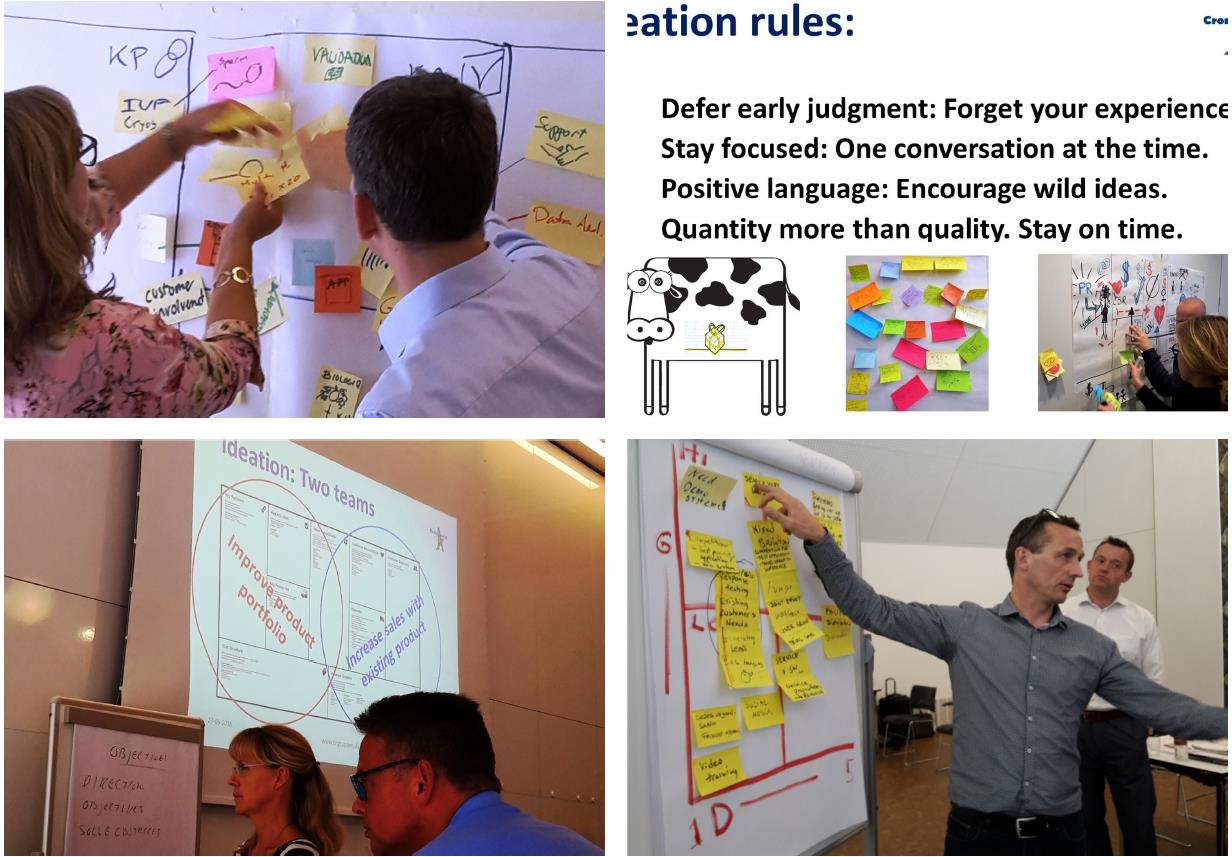
Business model + customer value + ideation
A strategy seminar at Rungstedgaard for 10 participants, built around business model generation and strategy design: the Business Model Canvas, value proposition, customer pains and gains, and customer value. Teams generated ideas, presented and qualified each other's work, and the output was brought together in a dashboard, a Strategic Game Plan, critical success factors and personal action plans.
Business model → customer value → ideation → qualification → strategic choices → action
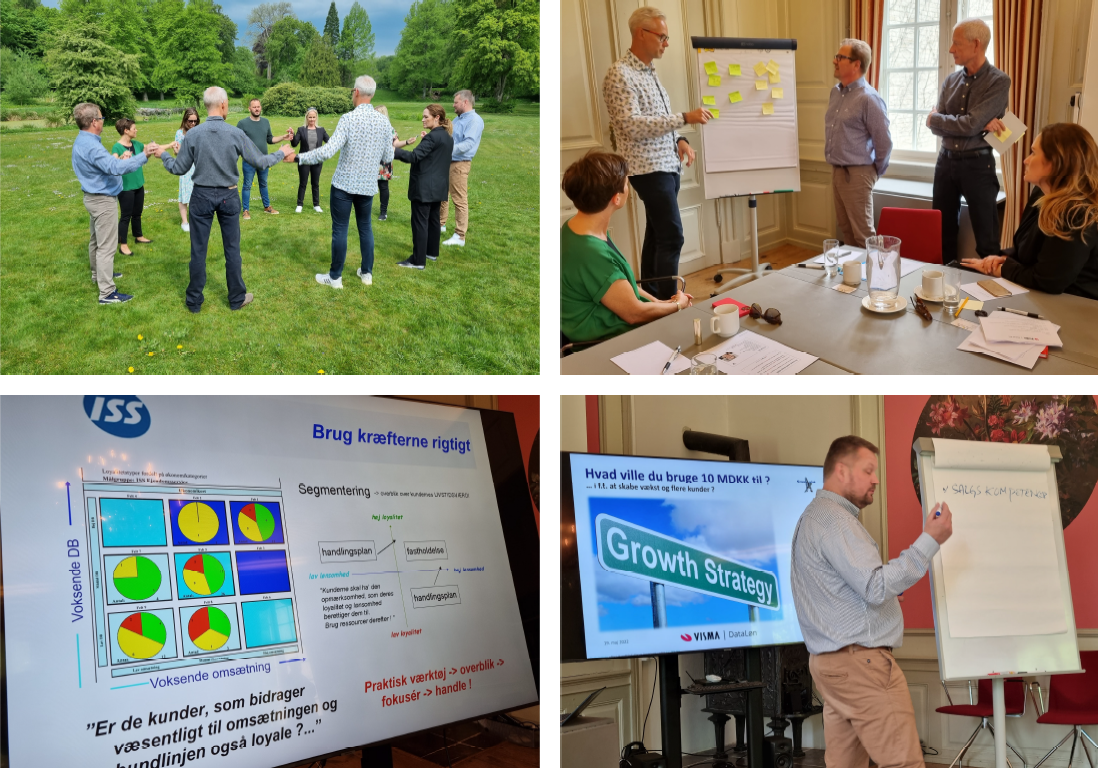
Growth + innovation + customer insight + business development
A strategy workshop at Skjoldenæsholm for a management team of 10, covering strategy and innovation, growth and customer development. Conventional assumptions were challenged – among other things with the ideation exercise “What would you spend DKK 10 million on?” – alongside work on promoters and churn, customer loyalty and profitability. A buddy walk, individual reflection and commitment, indoor and outdoor activities, and dinner together helped turn the ideas into strategic priorities and actions.
Growth → innovation → customer insight → business development → strategic choices
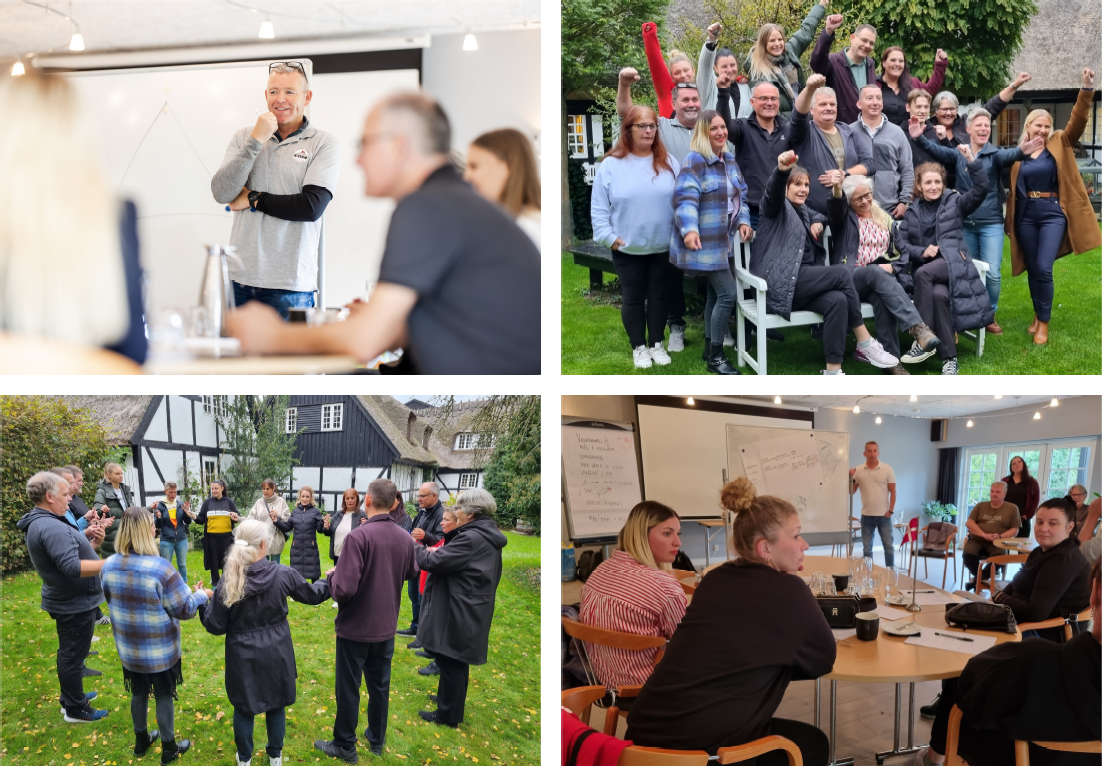
Strategy + leadership behaviour + team development + organisational alignment
A two-day leadership seminar at Slangerupgaard that built on the learning from the previous seminar. Practical team exercises were followed by evaluation and learning points and linked to leadership behaviour through the Behaviour Triangle (maintain / phase out / develop), knowledge-sharing exercises and a shared mental map. Working in three organisational teams – East, West and Back Office – participants worked through the Strategic Game Plan with visual action planning, then presented and qualified each other's work. The programme also included feed-forward, a listening exercise, personal reflection, JTI and psychological preferences, change management with the Change Wheel, business-buddy reflection, food team building and dinner – ending with a revised Strategic Game Plan, expectations for the coming business year and a shared commitment.
Experience/exercise → evaluation → reflection → behavioural insight → strategic work → shared action
Cronquist Consult facilitates the sessions where management needs to reach shared decisions: strategy seminars, leadership-team workshops, customer workshops and kick-offs that launch a programme or initiative. The aim is not a good day out, but a decision the organisation can act on.
Examples, not fixed formats. The process is designed around the assignment.
Short professional inputs · facilitated dialogue · individual reflection · group work · practical exercises · buddy work · walk-and-talk · visualisation · presentations · mutual qualification · prioritisation · commitments · social time · dinner/overnight stay where relevant.
Practical exercises and inspiring venues are part of the learning and process design – not entertainment detached from the business purpose.
The facilitator's role is to design the process, keep focus and pace, and make sure the difficult questions are asked and answered. Management owns the content — we make sure it becomes concrete, prioritised and shared.
Cronquist Consult designs and facilitates highly participative workshops and seminars on strategy, strategy execution, organisational development, business development, leadership, customers, growth, innovation, and organisational behaviour and collaboration.
Participants don't just sit through presentations about strategy or change. They analyse, challenge, generate ideas, discuss, test, qualify, prioritise, make choices and commit – and translate the work into concrete actions.
Most companies we meet have a sound strategy. What is missing is the translation: who does what differently next quarter, what do we stop doing, and how does management follow up when daily operations take over?
A strategy has to be explainable in short form and understood by the people who have to carry it out. If it cannot be, it becomes a document rather than a direction.
Strategy is about choosing direction, time and means — and about deselecting. We help make the choices concrete: few priorities, unambiguous ownership and measures you can actually see in daily operations.
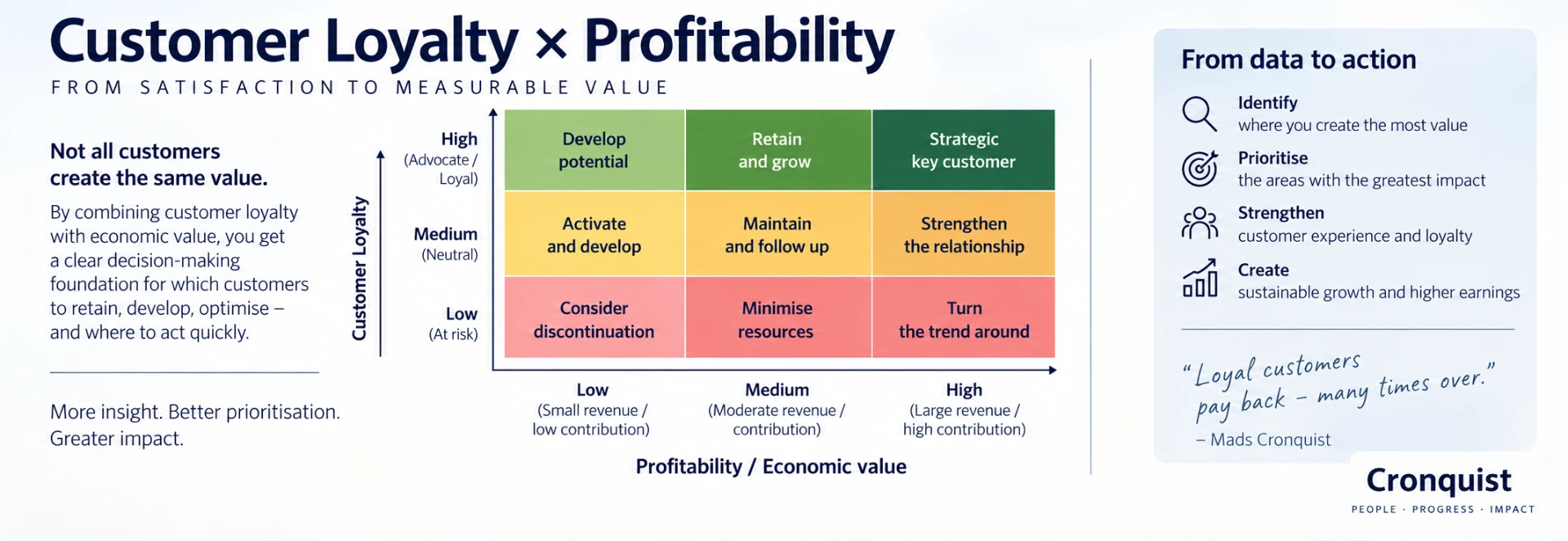
Execution is decided by leadership behaviour. What leaders ask about, follow up on and accept becomes the organisation's real priority — regardless of what the strategy says.
That is why we always work on the leaders themselves at the same time: how they run meetings, delegate, give feedback and hold people to agreements. This is where the difference between management and leadership becomes practical: creating order is not the same as being able to take an organisation through change.
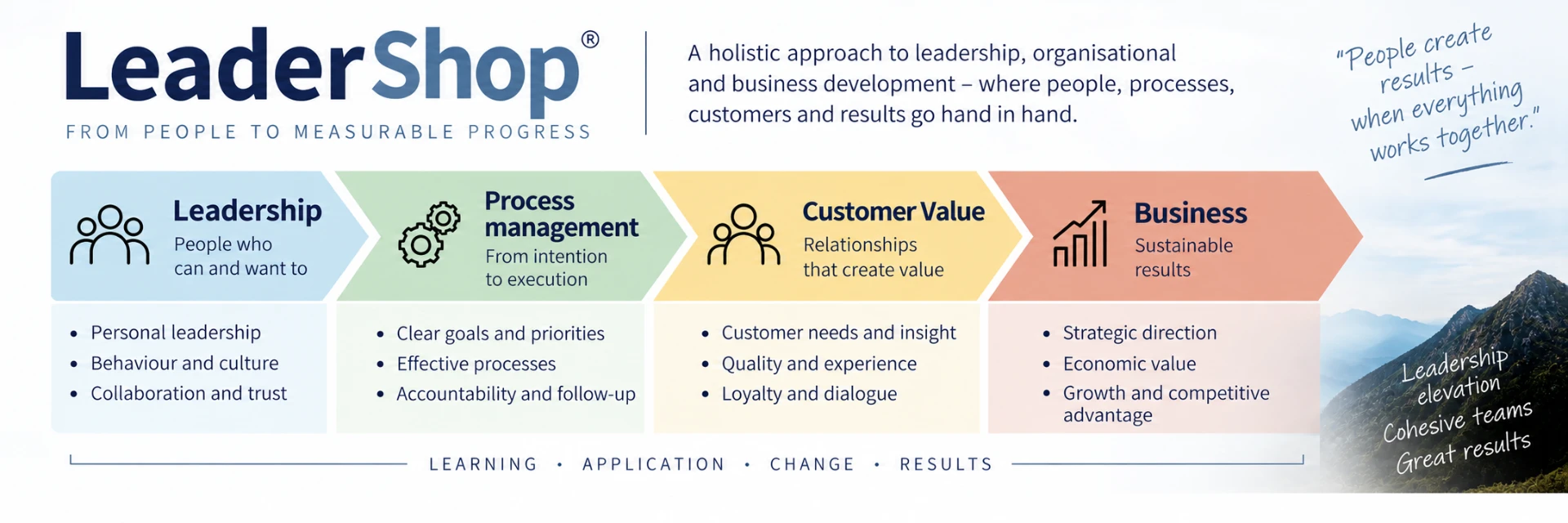
LeaderShop connects leadership behaviour with management, customer value and business, placing execution in a wider organisational context.
Strategy places demands on the organisation: roles, interfaces, meeting structure, decision paths and competences. If the structure rewards the old behaviour, the structure wins.
Culture is not changed with slides, but through the decisions that are made and the behaviour that has consequences. That is why we work with culture as something you can feel in everyday decisions.
Strategy only creates results when the organisation has the capabilities, structures and leadership capacity required to execute it. We therefore connect business goals with organisational capabilities, competency needs, development activities, concrete milestones and measures – with customer and business value as the ultimate outcome.
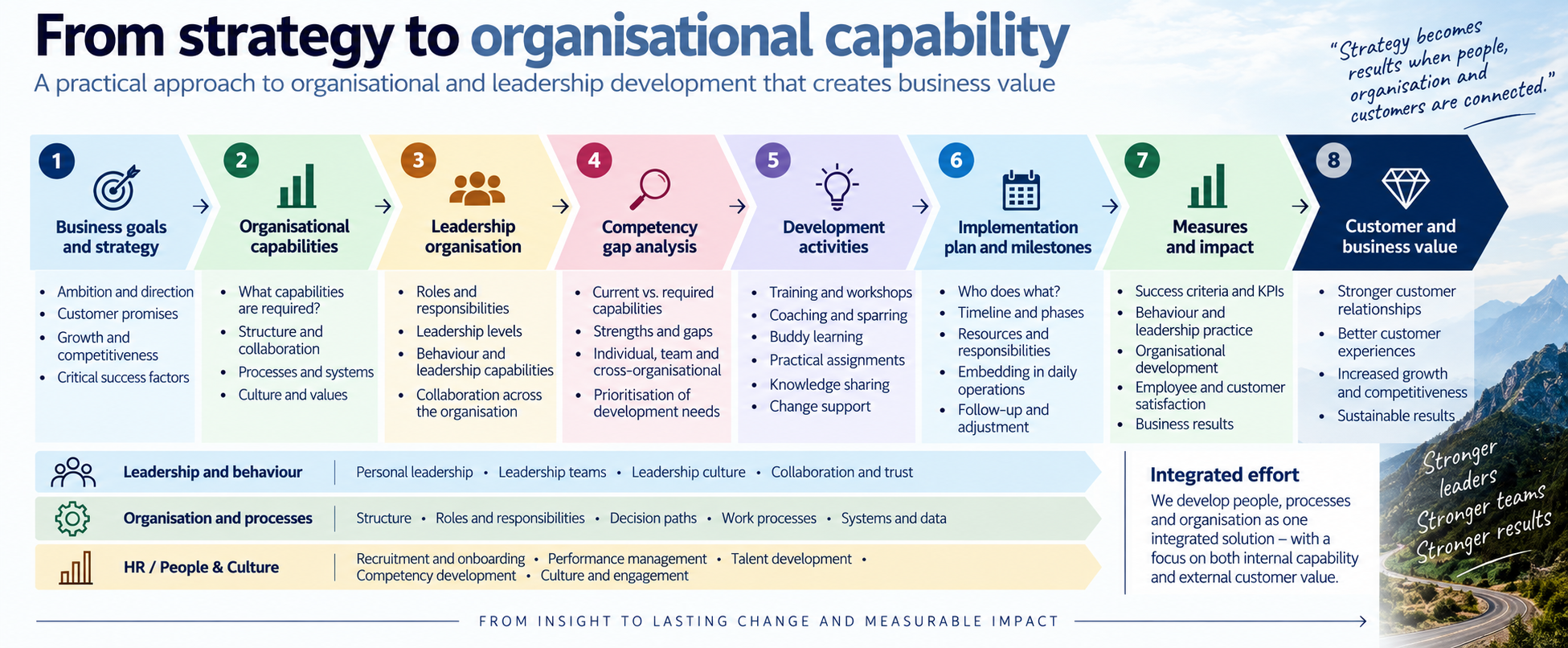
A workshop rarely stands alone. Decisions are turned into initiatives, ownership and follow-up and, where needed, the workshop is connected to leadership training and a regular rhythm, so what was agreed actually happens in daily operations.
We combine recognised leadership and strategy models with our own proven methods — for example, Balanced Scorecard when goals and follow-up need to connect, and the Business Model Canvas by Osterwalder and Pigneur when the business model needs challenging. We also work on customer value through deep-dive processes where customers are involved early and ideas are tested in practice rather than analysed to death.
Customer Deep Dive is our way of making sure strategy, competences and behaviour are developed from the customer's reality rather than internal assumptions. It is a method, not a product: it can be used in a strategy process, in a leadership programme or as a stand-alone investigation ahead of a decision.
There are three ways to bring the customer in. They can be used separately or together, depending on what the task requires:
Insight only creates value once it is acted on. Whichever of the three routes is used, we keep working with the same question: what needs to change in strategy, competences, behaviour and business development, now that we know this?
That is also why customer insight belongs on this page and not in an analysis department: it has to end up in priorities, leadership behaviour and follow-up — the same mechanisms all other execution depends on.
Markets, technology and customer behaviour move faster than a five-year plan can follow. So we work in short cycles: decide, test, measure, adjust. That requires leadership able to hold the direction while changing the means.
We have facilitated strategy processes and strategy seminars for management teams and worked on the implementation that follows — including strategy and business model development for an international start-up, and multi-year leadership programmes where customer focus, process leadership and production efficiency were the strategic centre of gravity.
Describe briefly what has been decided and where it stalls. We will come back with a proposal for how the task can be approached.
Talk to us about your strategy