Cases · Leadership team & execution · LEAP
LEAP – Leadership Execution Acceleration Program: an ongoing C-level programme in a large company operating within critical infrastructure
LEAP – Leadership Execution Acceleration Program – is an ongoing development programme for the C-level team of a large company operating within critical infrastructure. The purpose of LEAP is to strengthen overall leadership readiness, increase cohesion and execution capability within the C-level team, and contribute to improved business performance.
Not a conventional management course
LEAP is designed to connect personal leadership with the leadership team, trust, alignment, execution, organisational mobilisation and business performance.
The programme deliberately combines leadership psychology, leadership-team development, strategic execution, practical training, real leadership dilemmas, business sparring, reflection and feedback – and application in the participants' actual leadership work.
- Personal leadership → leadership team → trust
- Trust → alignment → execution
- Execution → organisational mobilisation → business performance
Programme architecture: five building blocks
LEAP consists of five modules that build on one another. M1 and M2 have been completed. M3, M4 and M5 are planned stages and are described here as part of the programme design – not as completed deliveries.
1. Foundation – M1 Leadership Readiness (2 days) · completed
Focus on personal leadership, individual and collective leadership readiness, personal development objectives, leadership dilemmas, psychological safety and feedback – and on identifying behavioural patterns and barriers.
M1 included 1:1 preparation and interviews, buddy work, practical exercises and reflection.
2. Trust – M2 Shared High Team Standards (1½ days, residential) · completed
Focus on stronger relationships, trust, psychological safety, shared responsibility, mutual accountability, effective collaboration and execution.
M2 built on M1 and moved the work from individual leadership readiness towards the leadership team defining and testing its own Shared High Team Standards (SHTS).
3. Alignment – M3 Change Leadership (2 days) · next stage
Planned focus on alignment around strategy, priorities, concrete business cases and a shared mental map for change.
4. Acceleration – M4 Execution Capability (2½ days) · planned
Planned focus on performance, execution discipline, strategic execution, customer value and individual coaching.
5. Mobilisation – M5 Integration (2 days) · planned final stage
Planned focus on integration into everyday leadership, organisational mobilisation, anchoring learning and new leadership behaviour, and a final team-based integration and examination.
From M1 to M2: from insight to shared standards
M1 asked: Who am I as a leader, what patterns do I bring into the team, and what does stronger individual and collective leadership readiness require?
M2 asked the next question: How do we convert that insight into stronger trust, shared behavioural standards, mutual accountability and more effective execution as one leadership team?
The planned M3–M5 stages extend that progression towards alignment, acceleration and organisational mobilisation.
Methods and activities in M2
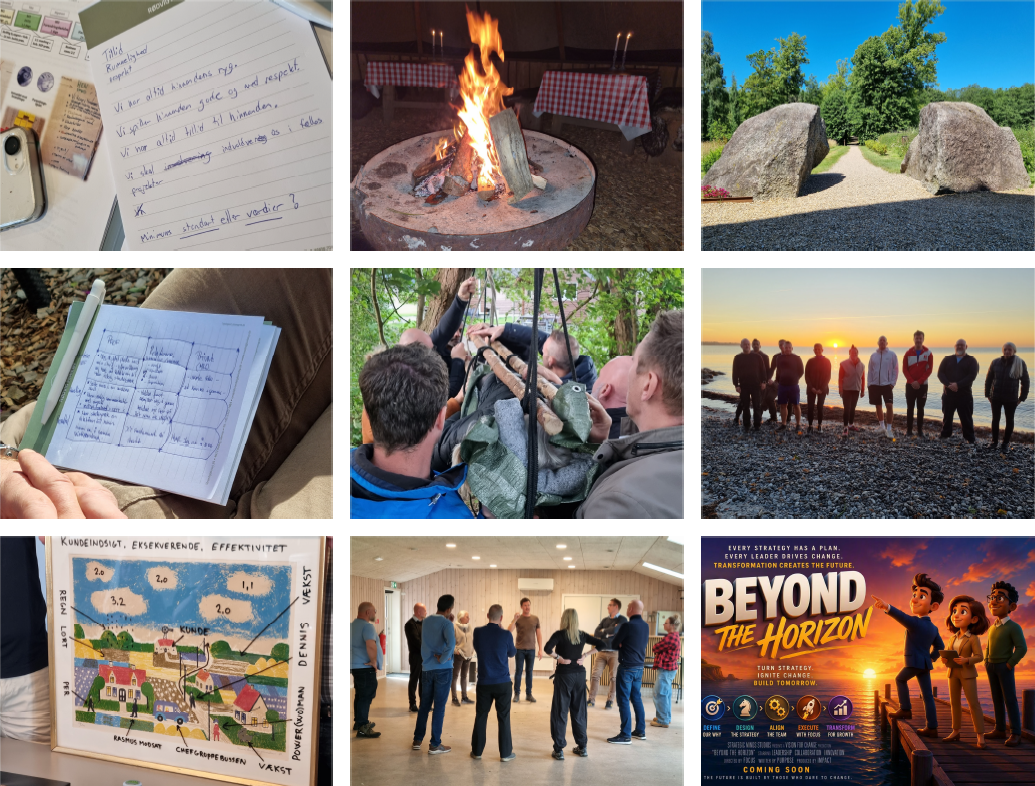
M2 combined several Cronquist Consult methods with practical, action-based learning. The team's specific outputs and internal standards are confidential.
- Success Analysis and identification of individual and shared High-Performance Patterns
- Outdoor trust exercises and a practical collaboration task
- Creating and refining the team's Shared High Team Standards
- Proactive ask-first feedback and self-reflection
- Buddy follow-up
- Firestorm (Ildstorm) as a facilitated change-management dialogue
More than module days
LEAP is not limited to module days. Where relevant, the overall programme architecture includes 1:1 interviews, 1:1 coaching, business sparring, observation of leadership-team behaviour in real management meetings, reflection on actual leadership behaviour, a buddy structure, homework and preparation, participants' own business cases, practical application of tools and real leadership dilemmas.
The design also includes planned involvement of customers and middle managers during the programme, and a final team integration. Not all of these elements have been completed yet.
Methods that support the business
LEAP combines Cronquist methods and established leadership approaches: Immunity to Change, Success Analysis, the High-Performance Pattern, Shared High Team Standards (SHTS), the Change Wheel, Strategic Game Plan (SGP), Firestorm (Ildstorm), proactive ask-first feedback, psychological safety and practical, action-based learning.
The methods are not an end in themselves. They support the link between leadership and business: strategy, priorities, collaboration across functions, execution, customer value, organisational change and business performance.
Status: From foundation to shared standards
The programme has been initiated, and M1 and M2 have been completed. The work has moved from individual and collective leadership readiness into trust, shared standards and practical testing within the leadership team.
The remaining stages will address alignment, acceleration and organisational mobilisation. As the programme is ongoing, this case claims no measured effects on performance, trust, execution or financial results.
Related services
Want something similar in your organisation?
Want to strengthen trust, alignment and execution capability in your leadership team? Tell us briefly about your situation and we will come back with a proposal – plus a free 30-minute intro call.
Book an intro call