
Option 1
In-house High Performance Team Programme
Tailored to your organisation
- Develop strong, self-driven teams
- Shared High Team Standards (SHTS)
- Practical training, cases and follow-up
High Performance Teams
We develop high-performing teams through practical training, shared standards and follow-up. Our work draws on 35 years of practical experience in Denmark and internationally – with clients including Novo, Visma e-conomic, Bang & Olufsen and Christiansen & Essenbæk.
Option 1
Tailored to your organisation
Option 2
Intensive training in unique settings
Also read about Leadership Team Development – when the whole leadership team needs to develop together.
We work with six core dimensions that together create a strong, cohesive and results-driven team.
Shared direction
Purpose, goals and what success looks like
Trust
The difficult can be said without it costing
Roles and ownership
Clear mandate – also under pressure
Standards (SHTS)
What is good enough, and who speaks up
Feedback and development
Feedback and learning day to day
Execution
Agreements become action
Results
A raised level, visible in results and behaviour

Training in practice
We combine theoretical insight with hands-on training, authentic experiences and practical tools that strengthen the team's collaboration, decision-making and ability to execute – in everyday work and under pressure.
Explore our methods, programmes and client examples below
A high performance team is not a team where everyone gets along. It is a team that deliberately works to a higher standard than it could get away with — and that holds the level when the pressure is on.
High Performance Teams are also described as high-performing teams. Whatever the term, the defining feature is the same: the team delivers consistently at a higher level than the task strictly requires, and holds that level under pressure.
The difference rarely lies in competence. It lies in standards, role clarity, feedback and execution — and in whether the team enforces them itself.
Standards are often where ambition becomes concrete. We call them Shared High Team Standards (SHTS) — the team's own observable standards for the behaviour it expects of one another when performance matters most.
Patrick Lencioni’s work on the five dysfunctions of a team describes several of these patterns well. We use established frameworks of this kind as a shared language.
Mads Cronquist's work with teams did not begin with team-building events. For more than 35 years he has built and led real teams — from a field hospital during the war in Bosnia to employee and leadership groups in private and public organisations. That practical experience is part of the foundation for our work with team building, team development and High Performance Teams.
No team effort survives a leader who does not hold the standard personally. The leader has to take the difficult conversation, hold people to agreements, and let the team solve what the team should solve. We therefore run the programme with the leader as a participant — and often with 1:1 coaching alongside.
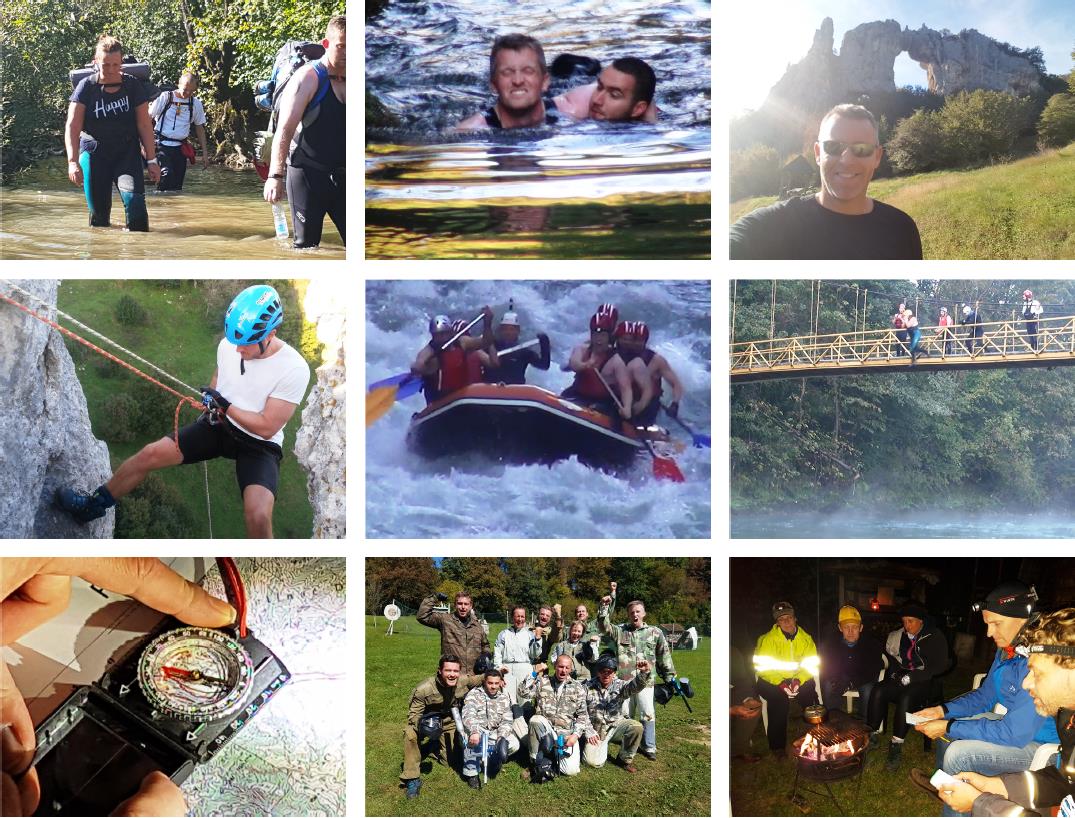
We work with changing learning arenas: the team is given tasks where collaboration becomes visible and where there is a real problem to solve. Afterwards we work in a structured way on what happened and what it corresponds to in everyday work. The patterns usually become clear in the tasks under pressure — not in the discussion of them.
Among other things we have delivered outdoor-based training in effective team leadership and longer team programmes for production teams, middle management groups and development teams.
The leadership team is the team with the greatest impact on the rest of the organisation. If you want to work on performance in the leadership team specifically, the starting point is leadership team development; if an operational team needs to develop over time, it is team development. Teambuilding, by contrast, is an experience that opens up collaboration. This page is about the teams that deliberately aim for an unusually high and sustained level — and that requires standards, roles, feedback and execution, not only good relationships.
Describe the team, the task and what is getting in the way. We will come back with a proposal for a programme.
Get a proposal for your team