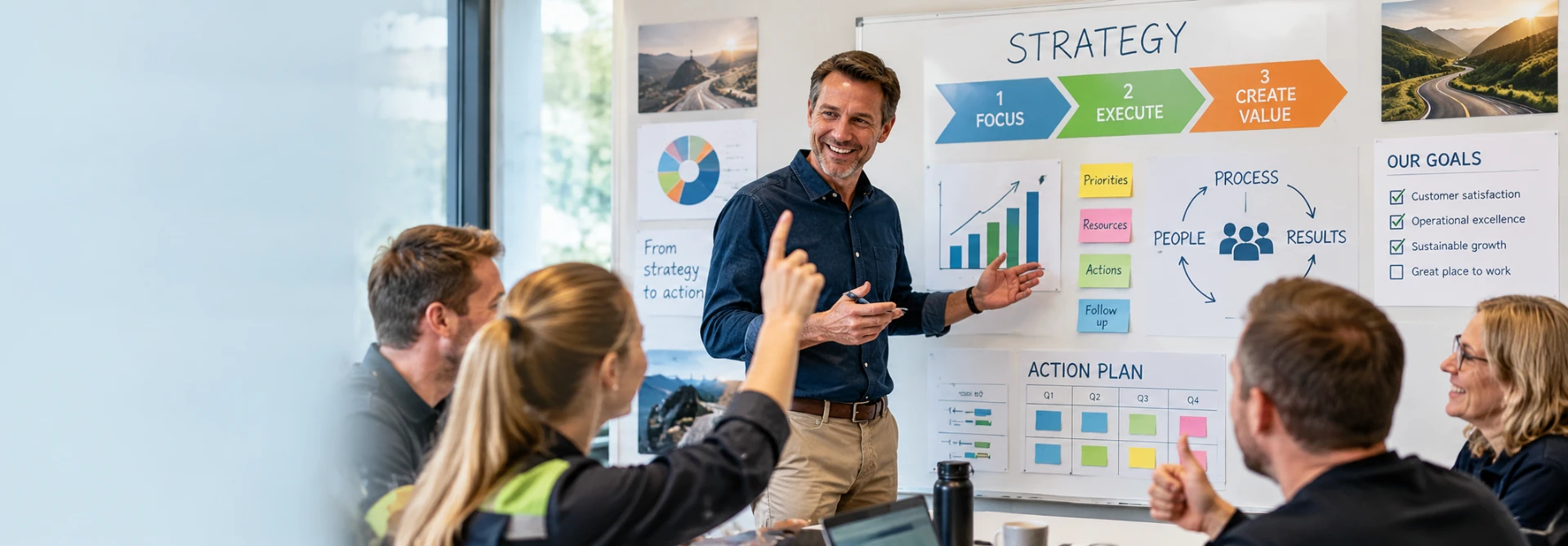
All good things start with the middle managers. I first made that claim in 2012, and it has only become more true since.
It is the middle manager who must translate the executive team’s strategy into something employees can act on come Monday morning. It is the middle manager who stands at the intersection of expectations from above and reality from below. And it is often the middle manager who is given responsibility faster than training.
This article is about why middle management is so crucial to strategy execution – and why developing it must always begin with the leader him- or herself.
The middle manager under cross-pressure
Few roles in an organisation are exposed to so many expectations at once. The executive team expects results and progress on the strategy. Employees expect meaning, stability and a leader who takes their everyday work seriously. Peers in the leadership team compete for the same resources.
In the middle of all this, the middle manager has to solve one of leadership’s most difficult tasks: translation. A strategy is, at its core, a set of intentions and priorities. It only becomes reality when someone turns it into concrete decisions, tasks and conversations in each individual department.
And the translation runs both ways. The middle manager must not only carry the direction down into the organisation, but also carry reality up to management: What works? Where is the resistance? What cannot be done with the resources we have? Without that feedback, the executive team is navigating by a map that does not match the terrain.
If the translation succeeds, the strategy becomes behaviour. If it fails, it remains polished slides. Yet many organisations invest far more in formulating the strategy than in developing the people who must translate it.
So what actually makes a middle manager a good translator? The answer does not begin with tools and models. It begins with the person.
Leadership IS personal
Leadership is about character and integrity. If there is no coherence between who we are and what we do, we lose credibility – and then the messages get lost, however well phrased they may be. As the saying goes: “What you are speaks so loudly that I cannot hear what you say.”
For the middle manager, this is especially visible. Every day, employees see whether the leader actually believes in the direction being communicated. They sense the difference between a leader who loyally passes on a message and a leader who has made it his or her own. Only the latter can truly translate.
Nor is there anything wrong with showing emotions at work. Nobody wants a leader with a stone face in both good times and bad. We want whole human beings we can identify with.
As a young officer, it took me many years to realise that if you want the group to run in the same direction, you cannot simply stand on a beer crate and give orders. You can do that once in a while – when you have earned the group’s respect.
Followership cannot be ordered. It has to be earned – every single day.
Respect has to be earned. But many middle managers never really get the chance to earn it, because they are thrown into the role without being equipped for it. And that often has to do with knowledge and power.
When knowledge is power
In a professional bureaucracy, knowledge is power and the glue that holds everything together. As the company grows, new young leadership talents arrive straight from university, and they can be perceived as a threat to the existing power bases. When power is threatened, we protect our territory – and knowledge sharing is avoided, to the detriment of employees, customers and the bottom line.
At the same time, the young leaders are often given responsibility for exactly the areas where the boss expects miracles. Naturally, that does not happen. At engineering school they never led an employee, met a dissatisfied customer or managed a budget.
It is not their fault. But it is the company’s responsibility to teach them. A skilled professional does not automatically become a skilled leader by getting a new title – any more than a good passenger becomes a pilot by sitting in the cockpit.
I have seen up close what this looks like when a company takes that responsibility seriously.
From trade expertise to leadership
In a construction company, leaders are rarely hired as leaders. They are appointed because they are good at their trade – and must then deliver results through other people, under time pressure and with changing crews. That was also the case at Christiansen & Essenbæk.
Here we developed leadership at two levels at the same time: a programme in foundational leadership for foremen and trade leaders close to production, and a two-year programme of 12 modules in advanced leadership for salaried staff and middle managers. Beyond the classic leadership disciplines, the middle managers worked with business, customers and strategy execution under pressure – and with their own tasks between modules, supported by buddy sparring and coaching.
The point was not only to make the individual leader more capable. When both first-line leaders and middle managers are developed in the same company, a shared leadership language emerges across levels. That is the prerequisite for a decision made by management actually being carried out on site.
I see the same pattern in entirely different industries. At Jobindex, the team leaders and supervisors had also been appointed on the basis of their professional skills, and the programme has been repeated and further developed six years in a row.
“The programme as a whole has really given us team leaders some good tools to work with, and helped us build the trust we need for our collaboration going forward.” – Participant, Jobindex
Tools and trust matter. But the experience from both companies is that what truly makes the difference happens one layer deeper: in the leader’s ability to mobilise him- or herself when it matters.
Inner Readiness
In 1998, shortly after returning from Bosnia, where among other things I had been project manager for the Danish Mobile Hospital during the war, I formulated the concept of “Inner Readiness” in an article in the national newsletter of the Danish Civil Defence Corps. The point was that it is the human aspect – our assumptions, deeper resources, emotions and courage – that determines whether we dare to step in and put things right when it really matters.
Today I describe Inner Readiness as the capacity built over time to consciously mobilise your mental, emotional and practical resources when the situation demands it – and to step down again afterwards. It rests on four elements: clarity to see the situation as it is, calm to create space between stimulus and action, courage to act even when the outcome is uncertain, and decisive action to turn the decision into concrete action.
I have had to draw on it myself. When I trained as a pilot in 2018, it required considerable self-overcoming, because 20 years earlier I had been involved in a plane crash. Inner Readiness is not the absence of doubt or fear – it is the ability to act clearly in spite of them.
That is precisely why the middle manager needs this discipline. The pressure comes from both sides, and without strong inner readiness the leader becomes either an echo of management or a shield for the employees. Neither creates execution. Like a pilot before take-off, the leader needs a pre-flight check.
A mental pre-flight check for middle managers:
- Clarity: Am I clear about the direction myself – or do I have doubts my team can sense?
- Calm: Am I acting from a conscious choice – or from old patterns and yesterday’s pressure?
- Courage: Which difficult conversation or decision have I postponed that the strategy requires of me?
- Decisive action: Do I know what the direction means for my employees’ everyday work – and who is my co-pilot who dares to speak up?
Inner readiness gives the leader a firm footing. But a firm footing alone is not enough – the translator also needs to know where to direct his or her gaze.
Zooming in and out
Almost 20 years ago, on our outdoor leadership courses, I started talking about “zooming in and out” in leadership. Just as a camera can zoom in and out, we can learn to consciously place our leadership in the right places at the right time. But nobody can zoom in and out at the same time.
Zooming in is about the details and the people: creating shared understanding, coordinating and getting different mental maps to point in the same direction. Zooming out is about the big picture: navigating by the larger milestones when complexity approaches chaos.
The middle manager’s typical trap is getting stuck in one of the positions: zoomed so far into firefighting that the strategy never gets any room – or so far out into strategy-speak that employees cannot use it for anything. The good translator moves consciously between the two – and knows when one is needed rather than the other.
It can be trained. In our programmes, this happens through fixed reflection time, training in difficult conversations and tough decisions, feedback that goes deeper than performance, and space for honest dialogue about uncertainty and pressure.
All good things start with the middle managers
My CBA thesis on LeaderShop was about systematically building the organisation’s overall leadership competence. One of the clearest findings was that all good things start with the middle managers. They are the key to success – but they can also become a millstone around the neck, especially if, as a leader, you deny your own potential for development.
It hurts an experienced leader to be told that they actually ought to learn more about people management. But as I had to accept as a young officer: all development starts with ourselves, and it requires a certain humility throughout life.
The effect is greatest when middle managers are developed together rather than one by one. Then a shared leadership language emerges, and the leaders can use each other as co-pilots in translating the strategy. That is the thinking behind our company-tailored middle management development, where the company’s own reality is the training ground.
Three things a company can do for its middle managers:
- Involve them early: Let the middle managers help translate the strategy – not just roll it out – and listen to what they bring back from operations.
- Train them together: A shared leadership language makes it possible to use each other as co-pilots – also across levels.
- Follow up between meetings: Fixed reflection time, buddy sparring, coaching and a boss who asks questions achieve more than yet another course certificate.
Conclusion – the translator must be ready first
Strategies become reality through the middle managers. That is why middle management is not a middle link, but a key link in all strategy execution – in both directions.
It requires leaders who have earned followership, who have worked on their own inner readiness, who can consciously zoom in and out, and who have had the opportunity to develop together with the colleagues they need to succeed with. And companies that equip them rather than expect miracles.
Leadership is personal. And all good things start with the middle managers.
This article builds on “The Personal Middle Management” (“Det personlige mellemlederskab”), which I wrote in 2012 and which was included the same year in Susanne Teglkamp’s book “I den gode ledelses tjeneste”.
Download the article as PDF
Read or save the complete article in a print-friendly version (5 pages).