Insights · 2 October 2026
Building real Dream Teams
Five real-life cases:
20 years of experience building Dream Teams in the workplace
How do you actually get people pulling in the same direction and optimize processes to create superior customer value and achieve ambitious goals – also known as that widespread phenomenon, "strategy execution"?
The answer is surprisingly simple. Here is how we did it in five very different organizations and under very different circumstances. The last as a consultant, the others as one of the team.
You can read the story of how the first Dream Team came about in Bosnia in From “Dream Team” in Bosnia to High Performance Teams.
1. Danish Mobile Hospital: The first Dream Team
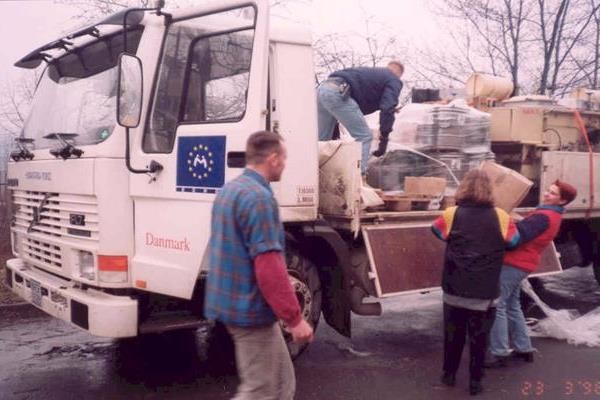
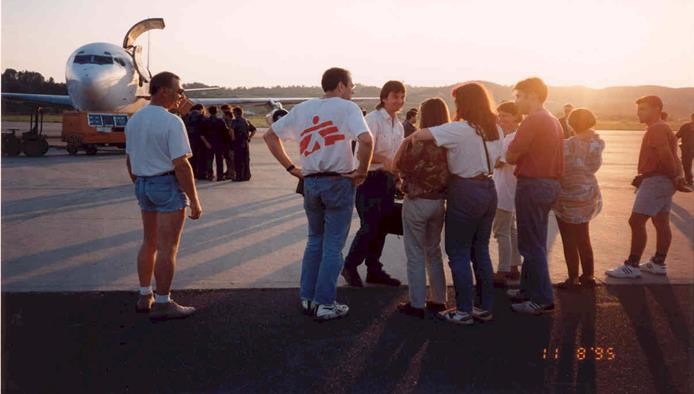
In June 1995, at the age of 23, I was offered the opportunity to go to war in Bosnia. With my education and training as an officer in the Danish Emergency Management Agency, I thought I had already seen most things, so I saw it as an opportunity to carry out some very important humanitarian aid work at Danish Mobile Hospital (DMH). I felt a deeper sense of calling. It came rather unexpectedly, but at exactly the right time.
Two weeks later, I was on a plane with Knud, a Danish police officer, and together we formed a management team. Knud was the project coordinator, and I was the technical logistician.
Unarmed, and after passing through 16 different checkpoints across the front line, we finally arrived in Banja Luka with Dr Finn Warburg, the originator of the pioneering mobile hospital concept. A handful of local employees welcomed us, and we immediately began the handover from the previous team. We also visited numerous local hospital directors, politicians, UNHCR, ECHO and a handful of other NGOs operating in the area at the time.
At every meeting with a local official, tradition dictated that we were offered a glass of Sljivovic – which, wisely, you never refuse! And probably two. Each about the size of a jam jar. Accompanied by some very strong coffee. After a few days, the previous team went home, leaving Knud and me to run DMH. Or at least to try. Needless to say, my stomach was in a terrible state, and my head was spinning. In fact, I could barely remember whom I had met or how to repair the hospital equipment when it occasionally broke down after being pushed to its limits 24/7.
The local employees did their best; some worked in logistics, some as interpreters, and others had medical skills. Operations were performed by highly skilled surgeons alongside local nurses. But the employees were not really functioning well as a team. Hardly surprising. It was wartime, and everyone was under enormous pressure. At the same time, we all depended on each other to deliver more than 100% efficiency. So what do you do?
Knud and I spent a great deal of time getting to know everyone on the team. We talked with them and worked side by side for 16–17 hours a day, seven days a week. We shared the hardships and tackled impossible challenges under very difficult and, of course, dangerous conditions. This might mean crossing front lines to deliver humanitarian aid – medicines, ambulance services, establishing local mobile clinics for primary healthcare, and so on.
We ate the same food, travelled in the same truck, carried the same burdens and supported the medical staff in saving patients' lives – regardless of nationality, ethnicity or religious belief.
"Alignment" began to take on a very concrete meaning for me. First, it was about getting to know myself far better, pushing beyond limiting and imagined boundaries to my energy, and trusting myself and my ability to accomplish almost anything; a training concept I now offer under the name "Inner Leadership Readiness". Second, it was about building real, tangible trust, so that we could rely on one another – even when it meant placing your own life in a team member's hands to save someone else's.
I personally carried three of my team members out of the area in my arms following, respectively, a nervous breakdown, a suicide attempt and a serious injury. We did not do it to achieve any kind of "hero status". We did it because it made sense – and because we felt like a family, through good times and bad.
But unlike a family, some had to leave and new employees arrived. By combining a well-prepared induction plan with open questions to each new "family member" about the skills, knowledge and energy they brought to the team, we began to grow together. Self-leadership became established in every member, and day-to-day management became more or less unnecessary – except in very special situations involving a treacherous cocktail of fear, chaos and the resulting paralysis.
In those situations, clear direction was needed to lead each team member – without debate or challenges to authority, because you had earned their trust and respect to lead when it really mattered. Later in life, I rediscovered this mechanism in many organizations and called the training method "zooming out/in"; leadership versus management. The model is called ROSE and contains five elements.
My contract with DMH was for only three months, but I did not return to Denmark until December 1997, after two and a half years of hard-earned experience – where it was literally a matter of life or death – as, after my first year at DMH, I also worked for MSF-Holland and Germany's Malteser Hilfsdienst. It gave me essential practical experience of how to build High Performance Teams in real life. Or, as the local employees themselves chose to call our little family: the "DMH Dream Team".
The results speak for themselves: DMH, later renamed Danish Emergency Mobile Hospital, saved many lives by performing several thousand error-free operations under extreme pressure, and we received the European medal for extraordinary humanitarian efforts. The hospital helped relieve pain and suffering for close to a million civilians in Bosnia and paved the way for effective mobile hospital concepts.
The concept still exists today in an even better version and has been deployed on several operations around the world, including in the aftermath of tsunamis and earthquakes.
Almost 20 years after my first visit to Bosnia, in 2014, I established OLTC (Outdoor Leadership Training Center) together with a former DMH employee – my close friend, and someone I consider family, Zeljko Bozic. Its purpose is to train leaders to become comfortable building Dream Teams, making difficult decisions under intense pressure and achieving ambitious goals. We now deliver genuinely demanding and exciting leadership courses throughout Europe, all year round – on land, on water and in the air.
2. ISS: Creating brand value
After Bosnia, I began my civilian career at ISS in 1998 as a management trainee. It was an enjoyable period in which I learned all the basics of cleaning, facility management, food services, snow clearance and so on. Gradually, I moved into management positions, initially as an operations manager in the Property Services division, where I was given a new team of around 30 employees. A few years later, I was promoted to Head of CSR, with several nationwide projects managed by some exceptionally capable project managers. We also established a rapidly growing temporary staffing agency.
It was largely about partnership: the ability to trust a partner with a completely different and complementary set of skills, so that together you can fight to achieve a common goal.
Once again, my experiences from Bosnia proved useful. We created another Dream Team and put ISS on a map where the company had never been before: as a leading commercial CSR player in Denmark. The team of 12 project managers and I met regularly at internal conferences to share knowledge, frustrations and ideas, and to refine our operational best practices. If someone had too much on their plate, a colleague stepped in.
A little curiosity deserves a mention here. As on several occasions during my time at DMH, senior people in Denmark often told me, "It can't be done." One particular person from ISS headquarters furiously told me over the phone one morning, "If you and your team want to pursue that nonsense, go ahead – but don't expect any help from us!" Okay, thanks. That merely added more fuel to my determination to succeed anyway. My boss, Ole Mortensen, also had my back.
I told the team that it looked as though we might be on our own and would have to prove our worth – in keeping with ISS's mission. "Are you willing to buy into that?" I asked them. Once again, the Dream Team rose to the challenge and threw itself wholeheartedly into the task together.
Together with the Municipality of Herlev, under the leadership of the former head of the job centre and highly visionary public official Niels Tolstrup, we developed a highly practical and useful "Multi Service" concept.
We expanded the collaboration to include, among other things, an unprecedented creative concept for integrating foreign nationals into Danish society, which evolved into a full-scale knowledge institution advising the public sector.
The results were quite impressive. The team delivered the group's second-highest profit margin, proved that newspapers could write positively about ISS and thereby create brand value, and won several awards. Dream Teams dream big – and execute with intense focus to fulfil their important mission, whatever obstacles they encounter.
3. Eltel Networks: HR in the line of fire
In 2004, I left ISS to start my own consultancy, drawing on my experience of partnerships, and invented the world's first Video CV. A few years later, just before anyone seriously noticed the tidal wave of the financial crisis gathering force, a former ISS director contacted me and asked whether I would become HR Director, with a seat on the management team, at one of the leading infranet providers, Eltel Networks.
After some consideration, I accepted and began as a part-time external consultant, later becoming a full-time employee. The assignment was to build an HR function from scratch, with a particular focus on leadership development.
Sonny Nielsen, the CEO, was a hard-line boss, which was necessary at the time. Gradually, I built the HR department with a team of five dedicated employees, coincidentally all women. I outsourced legal matters, separated payroll and transferred it to Finance. Together, we developed a comprehensive leadership education concept combining blended e-learning, practical outdoor exercises, coaching and homework assignments. Essentially, it was an internal academy.
When it was time to develop the next HR strategy, I asked Sonny to spend a little time with us at an HR departmental seminar. He was to explain and outline his expectations and requirements for HR's value creation, seen through his own eyes and those of Eltel Networks' customers. He did so with a precise and clear vision in 15 minutes. Quite impressive.
Based on this and our own preparation, including open questions ahead of the seminar, I brought along a prototype of a model I had developed as an independent consultant. It was designed to align our HR initiatives with the various business objectives and was inspired by a combination of Kaplan and Norton's good old Balanced Scorecard and Dave Ulrich's four original HR roles. I called it the "LeaderShop" model.
We worked hard as a team with mind maps, Appreciative Inquiry and our individual contributions to create a strategy that delivered genuine value on three levels: (1) supporting managers in creating customer value by making it easy to "shop for HR"; (2) demonstrating and calculating the value created for management; and (3) assigning each task to an individual HR team member with clear, measurable goals (success criteria), deadlines and responsibilities.
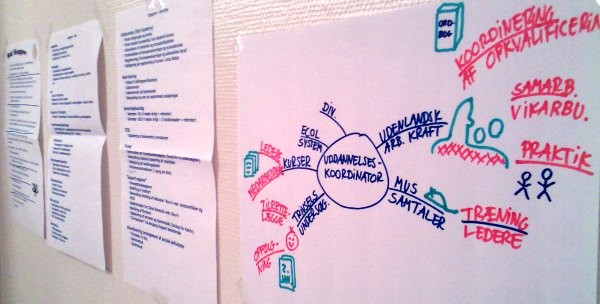
After further homework, the LeaderShop model was condensed onto a single A3 sheet (42 × 30 cm) and displayed on the walls both inside and outside the HR department – which, incidentally, was organized with HR partners embedded in the business units. It was also used as the basis for reporting to management.
Although the financial crisis hit, Eltel Networks managed to improve its profit margin by approximately €3.5 million in one year.
Annual sickness absence fell by 50%, and employee turnover was reduced to less than 25% of its previous level. The academy delivered more than 2,000 training days, and a partner and I also developed a highly effective internal IT system, "Employee Circle of Life" (ECOL), designed to bring HR into operations and make it easy to use.
For example, I discovered that onboarding a single new employee involved 16 different people. With ECOL, we automated 75% of these processes and saved around €1 million in operating costs. The Employee Satisfaction Index improved in 90% of the targeted areas, and we implemented systematic induction and exit programs.
In operations, we were able to document non-billable hours, and we built a strategic workforce programme to reduce costs and improve efficiency – and once again, just as at ISS, an internal temporary staffing agency.
But all good things come to an end. Once the HR department was fully operational and running smoothly, we ourselves came into the line of fire. Eltel Networks had been acquired by a private equity fund which, during the financial crisis, was hardly in love with the HR functions in the different countries. So in the summer of 2009, it was time to say goodbye to a fantastic Dream Team. And just as at ISS, you start cleaning the staircase from the top – which meant I was the one swept away.
It turned out to be one of the best things that ever happened in my career.
4. Christiansen & Essenbæk: Getting rid of the concrete block
When I left Eltel Networks, I restarted the engine of my consultancy and gained several years of useful experience in business development across different companies. One day, as chairman of Network Greater Copenhagen, I attended a conference near my home. A speaker named Helle shared something very interesting about a project in a medium-sized construction company I had never heard of: Christiansen & Essenbæk (CEAS).
Helle was the project manager, and I invited myself for a cup of coffee to meet her, hear more about the project, called "Trivsel – 360 grader" ("Well-being – 360 Degrees"), and help her with the financial reporting.
Helle did not feel particularly comfortable in the job and wanted to try something else. By coincidence – or perhaps something greater than fate (synchronicity?) – Helle wanted to establish the "Youth Fire Brigade" in Copenhagen. As a former smoke-diving instructor and incident commander, I knew a few tricks of the trade and helped her with the application, which actually resulted in her getting the job. A few weeks later, I received a call from Helle's former boss, CEAS Managing Director Jon Buch.
"You bastard ... you made Helle leave, so you'd better come and take over her job!" he said, with unmistakable humor in his voice. Without a moment's thought, I immediately replied, "Like hell I will!" The strangest job interview ever.
Nevertheless, we met for coffee a few days later to perhaps take the conversation a little further. Jon told me about his ideas and the efforts he had already made to build a better company. I was struck by his honesty and commitment to creating far better conditions for the employees. The company was growing rapidly, but at the expense of a positive working environment; it faced operational failures and desperately needed a major improvement in leadership quality throughout the organization.
As I listened, I once again felt drawn towards something very difficult: getting rid of a kind of concrete-block mentality that, like a ball and chain, stood in the way of visionary opportunities. We could do this together.
I told Jon I would take the job on one condition: it must not be a project. It had to be implemented through an HR development function, including training managers as pioneers, so that we would create yet another Dream Team from within. In 2011, I once again put my consultancy on standby and stepped into the role of Head of HR Development.
I began by putting myself in the employees' shoes, actually taking part in the work – repairing motorway bridges and tunnels – simply to get to know my colleagues and their tasks. I looked fantastic in my fluorescent yellow workwear. After a few days, my back ached and my ankles were swollen. It made me think. Some people had been doing this work for decades.
One morning, I joined the carpenters for their morning briefing and breakfast in the site cabin, but I had forgotten that they wore white workwear. An older and very experienced fellow named Christian looked at me and said bluntly, "Mads, this is going to be difficult, isn't it ...", pointing at my clothes. I realised I looked like a highlighter pen. Or perhaps a fluorescent idiot.
Christian, whom I initially took for a grumpy old man, later proved to be a trusted team member and a dedicated pioneer in the company.
At the first meeting with the operations managers, I explained the vision and the activities we were going to launch. They just stared at me in stunned silence, with absolutely no team spirit. Clearly, I had made a mistake, so I started thinking about how to motivate the management team – step by step.
I remembered my own "Firestorm" model and approach and launched the idea: instead of explaining the grand vision and all its elements, I would simply start by finding one person in the team willing to be a "firekeeper" for one activity, such as morning exercises. Then find another team member and launch something else – appealing to their inner desire to contribute to the success of the entire company, in other words, to lead themselves.
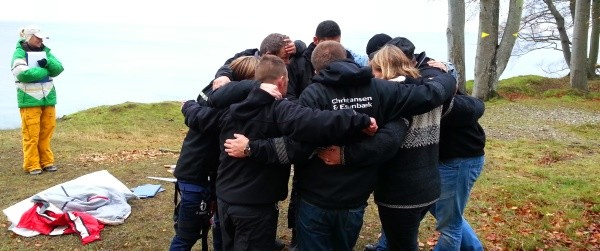
Slowly, step by step, like a circle of fire, you create a firestorm moving towards the centre – the actual goal – and the energy and radiant heat grow and spread like wildfire. This simple form of strategy execution works extremely well. The enthusiasts number roughly the square root of the organisation's size and share one particular trait: they have a spark in their eyes that can be ignited if you "blow on it" in the right way. If they are not enthusiasts, however, they just think you have bad breath.
Our primary objective had two parts: (1) optimise processes and reduce sickness absence, and (2) bridge operational management and personal leadership. Within two years, everyone in management had completed a comprehensive leadership development programme, and everyone in the company participated in various activities to strengthen our overall health-related skills and internal teamwork.
This included some fairly crazy things, such as my inventions "site-cabin yoga", packed-lunch training and ergonomic exercises in the workplace using the existing equipment out on the bridges being renovated. There were also IT skills – we built an intranet in two weeks – morning exercises, a strategy seminar using Osterwalder and Pigneur's Business Model Canvas, conflict resolution through interactive forum theatre, and business finance for non-financial managers using poker chips, to name just a few.
We created a visual, interactive presentation of it all in Prezi and talked about the concept and its activities at conferences and seminars far and wide. The interactive Prezi project presentation was made by my HR team colleague Sanne Wognsen and was named "Plysmåge" – don't ask why.
Once again, this Dream Team rose to the challenge and achieved incredible results: the overall competence development programme significantly improved process efficiency, reduced sickness absence by more than two-thirds and lowered potential occupational health and safety risk factors by 30%. Together, these improvements helped increase the company's net earnings by around DKK 10 million, on annual revenue of DKK 150–200 million. That is close to impossible in the construction industry.
But Dream Teams are motivated by the "impossible". At the end of the two-year programme, we orchestrated a major employee gathering with lots of activities at the company. A Dream Team of hourly paid employees, including Christian, took 100% responsibility for the event. Danish Broadcasting Corporation (DR) heard about it and came to broadcast live for the 9 p.m. news. Christian spoke proudly, clearly and eloquently about his company.
Later, we completed another programme together and developed our own officially recognised training in concrete repair for his colleagues (the "BygOp!" project).
Ignited by the Firestorm this Dream Team had created, I also completed my CBA and, in about a month, wrote the book "Lederens inspirationsguide" ("The Leader's Inspiration Guide") about the entire programme and everything we had learned. The book was made freely available as a gift to current and future leaders.
In 2012, Christiansen & Essenbæk's "Trivsel – 360 grader" project was honoured with both Børsen's CSR Communication Award and the Working Environment Award in the strategy category. After some fantastic years, I felt my mission was complete, so I left the company and continued as an external consultant in leadership and business development. In 2013, CEAS developed a 24/7 concept for repairing motorway bridges that eliminated 80% of daytime traffic disruption.
The year before the original article was written, I took a group of CEAS managers to Bosnia for four days to train them to lead teams through difficult situations and execute tough decisions. Many people talk about "strategy execution", but how do you actually train this skill? We found an answer in OLTC and turned it into a special concept.
Jon also joined me and another team in France to climb Mont Ventoux by bicycle after a full year of training. I was the mental coach and practical logistician and also organized canyoning and rappelling. I am pleased to say that everyone in this Dream Team reached the summit and achieved their individual goals. They have my deepest respect.
5. e-conomic: Reaching for the stars
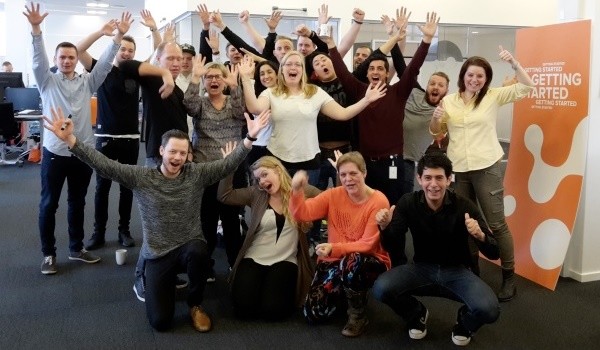
Shortly after restarting my business yet again, I received a LinkedIn message from my former boss at the Danish Emergency Management Agency, Kim Sneum Madsen. He had heard about my book and wanted to know if he could get a printed copy. It had been a long time since we had seen each other, so we met in his office. Kim had worked at the successful software and accounting company e-conomic for several years, now as SVP of Startup, Service and Support, and the company was growing rapidly.
We discussed the need to recruit and develop new managers internally. We agreed to meet again, this time with HR Manager Mads Petersen.
Mads, Kim and I came up with the idea of designing a special "Process Leadership" training programme. Three months later, we launched it with 10 participants. The programme comprised eight modules, half of which were delivered by my company. Our four modules consisted of (1) outdoor action learning in practical team leadership, (2) process leadership, (3) a deep dive into the customer perspective, and (4) a big surprise.
Module 1 focused on building confidence in leading teams using outdoor facilities in the forest near the sea, where Outfitter Kompagniet – a teambuilding and leadership training company I took over in May 2013 – had its base camp with a beautiful large tipi. During this module, team members were also introduced to some highly useful personal development tools that I had picked up during my training on the Pathfinder programme, which proved to overlap considerably with my own method called 3H.
In Module 3, we invited some of e-conomic's customers to participate and teach on the programme. This gave us their valuable input on product design and customer experience, including their frustrations, ambitions and candid comments. What customers love, miss or hate about your products and services – delivered unfiltered. This is a recurring method, called Deep Dive, which I have refined over the years and consistently use with my clients in various forms.
Throughout the e-conomic leadership development programme, which lasted around four to five months, participants were given a buddy, homework assignments and the opportunity for one-to-one coaching with me. Something profound gradually happened to the team members, both personally and as a Dream Team on a shared journey. As Kim said at the kick-off:
"The goal for you is to become a better version of yourself."
You often hear that as a rather fluffy consultant cliché, but here it actually happened, and it was a great privilege to experience it from the inside.
After four Process Leadership cohorts, we expanded our collaboration with the "The Way We Work" training programme, in which the company's values were translated into concrete behavior through outdoor learning – as human behavior in Dream Teams that create superior customer value.
My day-to-day contact in e-conomic's HR department was, incidentally, another interesting story. It was none other than Sanne Wognsen, who had been my colleague at Christiansen & Essenbæk. Together, we formed our own little Dream Team. I believed that she and her colleagues at e-conomic would one day reach the stars. The journey had only just begun, but this Dream Team was well on its way. The reason: they all possessed a great deal of personal courage – the fuel for all personal and business development.
The courage to accept that we are not yet perfect, and that precisely because of this, we can unlock enormous potential.
Perspective
In the book "Execution: The Discipline of Getting Things Done", Larry Bossidy and Ram Charan describe seven essential leadership behaviors as "Building Block One", including what I personally consider the most important: "Know yourself". The point is that emotional strength gives you the courage to accept views that conflict with your own, handle conflict and have enough self-confidence both to encourage and accept challenges in groups.
According to Bossidy and Charan, knowing yourself rests on four core qualities which together create this emotional strength: (1) authenticity, (2) self-awareness, (3) self-mastery and (4) humility. That hits the mark.
Joseph Jaworski, the bestselling author of "Synchronicity", also wrote "Source: The Inner Path of Knowledge Creation", inviting us on his lifelong journey towards understanding genuine leadership. A central point is that limiting belief systems can prevent leaders at all levels from pursuing and discovering new opportunities – resulting in repeated strategic failures, even in otherwise exceptionally well-run companies.
It is both a gentle warning and an invitation never to end the journey of personal leadership development.
Leadership is crucial to creating High Performance Dream Teams. Personal capacity is where it all begins. When you embark on this personal journey, over time it can make you your own handbook for standing strong – even under severe and sustained pressure.
Resilience and robustness are the essential foundations on which future leadership and Dream Team capacity are built. They are the key to successful strategy execution.
Summary
Alignment in an organization begins with getting to know yourself really, really well under pressure. How does that work? If you cannot trust yourself when trying to solve difficult tasks and achieve ambitious goals, why should anyone else? Would you follow a leader who does not trust themselves? Exactly. It takes a great deal of inner courage.
Process optimization is closely connected to alignment: your mental map of the world differs from everyone else's. By first listening carefully to yourself and acknowledging the vast inner potential of the "unknown" within you, you can let go of the fear of failure and open yourself to life's possibilities. Once you have done that, you are ready to listen to other people in the organization, appreciate ideas and improve process efficiency.
The next step is to understand the customer's perspective in order to deliver superior value. It is not that complicated. In fact, it is quite simple.
Building Dream Teams starts with YOU. The determination, execution and persistence involved in becoming a better version of yourself. This will lead you and your Dream Team towards executing an ambitious and successful strategy, reaching the goal – and perhaps even the stars. In that order.
Passing the baton
At a certain point in my life, I felt that the time had come to pass the baton on – while there was still time. At 43, I practised becoming a better version of myself every day. When I lost sight of my own vision, made mistakes or stumbled and fell, I got up again and continued the journey.
During a masterclass in Canada in the autumn of 2014, I woke at 4 a.m. and heard wolves howling beneath the clear, starry sky. It was as if they were calling me, so I got up and walked out into the forest in the pitch-black night, illuminated only by the twinkling stars. There, in the complete silence – broken only by the wolves prowling around me – my purpose in life suddenly became very clear.
I had a small candle with me, which I lit – and felt energy flow through me, igniting yet another inner Firestorm. Just as with this article, within a few hours I sketched out "Fremtidens Lederberedskab" ("Future Leadership Readiness"), which would become my gift to the small village where I lived.
It was a one-year pilot programme for 16 young teenagers, combining five demanding, character-building outdoor training expeditions/modules lasting two to four days at my base camp on Stevns and at the Danish Emergency Management Agency, on my beloved island of Anholt, in the Swedish wilderness, in the Austrian Alps and in Bosnia, together with one and a half hours of voluntary weekly homework support for the whole group in my living room every Thursday evening.
It was my future Dream Team's journey and my wish to leave something behind that would outlast me.
And so I did. During the 2015–16 school year, we ran the first programme for 16 ordinary sixth-grade pupils, with an equal number of girls and boys. It exceeded all expectations, not least because many other volunteers joined in, and together we created a small, shared Firestorm in a village. It spread to the next year group, so we did it all over again.
I devoted approximately 1,600 unpaid project-management hours, all my holidays and around DKK 300,000 in personal donations to make it happen. An investment in future leadership readiness: those who together can create a better welfare society than the one you and I grew up in – even with fewer resources, or perhaps none at all.
Impossible? It is just a word until someone proves otherwise. And that is exactly what Dream Teams can do.
About the author
Mads Cronquist (born 1971) is the founder and owner of Cronquist Consult ApS, a consultancy working in organizational and business development for a wide range of Danish and international clients, for example through leadership team development programs and hands-on strategic advisory services.
Mads trained as an emergency management officer and incident commander, is a veteran of humanitarian work during the war in Bosnia and has enjoyed a long business career in senior management roles across many positions and industries, including projects that have won international recognition and awards. He holds a CBA specializing in innovation and strategy, supplemented by education in business psychology, and is the author of several books. Mads is also a qualified pilot with his own aircraft – and lives by the motto: “The sky is NOT the limit; it’s a wonderful playground!”
Read more about Mads Cronquist: cronquist.dk/en/mads-cronquist
Cronquist Consult: www.cronquist.dk/en